
As scientists deploy ever more refined tools to show how humanity is destroying the biosphere – and what’s needed to avert full collapse – institutions of power remain allied to interests of global capital.
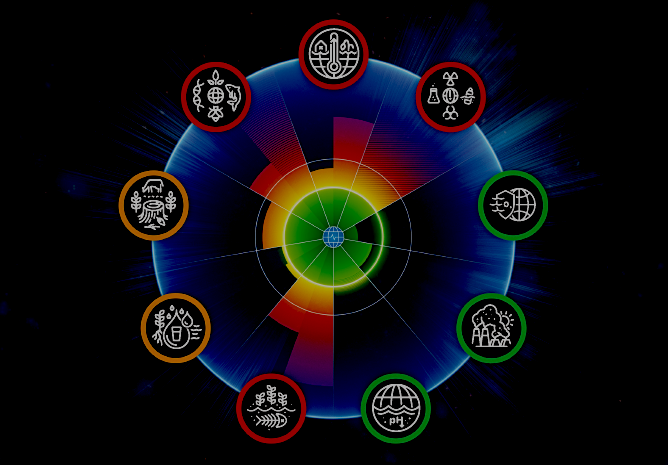
Under relentless attack from industrial expansion, the majority of the Earth’s nine categories of living system processes have now reached a critical and precarious state, according to a newly released, scientifically rigorous diagnostic framework called the Planetary Health Check (PHC).
The tool has found that, on top of the six planetary boundaries already breached by modern human enterprise, a seventh – ocean acidification – now also shows imminent risk of breach. All seven show a clear trend towards further transgression into danger zones.
(Those already breached are climate, biosphere integrity, land system change, freshwater change, biogeochemical flows, and the introduction of novel (chemical) entities – according to an earlier paper, published in September 2023.)
The situation is grave and urgent.
Living systems breakdown – still accelerating
The planetary boundaries – which delineate a “safe operating space” within which the planet’s living systems would remain stable and resilient – are not independent: a breach of one makes others less stable. With multiple boundaries now breached, the risk of irreversible and runaway breakdown of Earth’s living systems is already extremely high if not already underway.
Yet the world’s established networks of power, which include governments, financial institutions and the media, are still failing to respond proportionately.
The PHC, built by a new, multi-partner research initiative led by Professor Johan Rockström at the Potsdam Institute for Climate Impact Research, forms the basis of the first in a series of annual reports aimed at boosting efforts to protect the stability and resilience of Earth.
“By quantifying the boundaries for a healthy planet, we provide policy, economics and business with the tools needed to steer away from unmanageable risks,” said Prof. Rockström.
The signs that these sectors will make sufficiently serious use of those tools are not promising. It’s not hard to see why. An abundance of research from other sources, indicates that doing so would require an overhaul of the global systems of economics, finance and governance.
Urgent transformation required (still)
For example, in an extensive and detailed piece of research, more than 60 scientists from the Earth Commission found that keeping Earth within a “safe operating space” – as defined by Earth system boundaries (similar to planetary boundaries but incorporating human needs and impacts as well) – will require a dramatic reduction in inequalities, alongside urgent economic transformation.
Making it clear that overconsumption of finite resources by a minority of wealthy people is rapidly shrinking this space for everyone else, the research sets out detailed pathways for returning to this safe space. The research – published as a 60-page tour de force in the journal Lancet Planetary Health – demonstrates that justice is a prerequisite for the safety of the planet and people, and is said to be the first example of scientists quantifying safety and justice in the same terms.
Separately, researchers from Bristol University have shown that socially just and environmentally sustainable climate outcomes are incompatible with compound increases in material and energy use. Their Perspective piece, published at the end of August 2024, outlines opportunities to rethink shared socioeconomic pathways based on degrowth principles, drawing on a substantial body of evidence of the need for post-growth economic models for livable futures. (See also this, among others.)
Big-picture public discourse – still missing
The contrast between what is required for survival and what is actually happening is stark. Also released this month, an extensive report by Earthtrack finds that governments are allocating environmentally harmful subsidies to the tune of an astonishing $2.6 trillion/year globally. This figure is still growing. The subsidies present a continuing and devastating threat to nature and climate.
The evidence suggests that those with the power to initiate a systemic overhaul instead remain hostages to corporate hegemony, based on the ideology of capital accumulation for a minority.
Despite the disturbing dissonance between the above findings, particularly evident given their closely-timed publication, acknowlegement of the overall picture and its implications is largely absent from public discourse. At best, the dominant media soft-pedal the issue. For example, this from the Guardian, likely the best coverage yet of the PHC, talks in terms of “hope” and “consumption” rather than framing the crisis in terms of the political and economic systems holding the world in a ratchet death-grip.


'“Leaders” shun system-change imperative as scientists ramp up Earth crisis warnings' has no comments
Be the first to comment this post!